

You are not the only one experiencing slow WordPress website loading times; millions of other website owners and operators are experiencing problems with slow websites: poor or nonexistent website speed, high bounce rate, and low SEO ranking as a result of a slow loading web site.
In the year 2026, website load time will be just as important as ever. Visitors expect every website they visit to load quickly (within seconds) and, in today’s world, Google gives priority in their search engine results to fast websites.
If your website is slow, you are likely to have fewer visitors, lower conversion rates and poorer user experience.
Fortunately, you don’t need to have experience with coding to make improvements to your WordPress web site. We will provide a complete and easy-to-understand beginner’s guide to how to improve WordPress website speed through easy to follow steps.
No matter whether you operate a blog, own a business or run an online shop, the following tips will help improve the WordPress loading speed of your WordPress web site, increase your search engine ranking and enhance the experience for your site visitors.
Lorem ipsum dolor sit amet, consectetur adipiscing elit. Ut elit tellus, luctus nec ullamcorper mattis, pulvinar dapibus leo.
Why Website Speed Matters in 2026
The speed at which your website is loaded will impact:
- SEO Performance
- User Experience
- Conversion Rates
- Bounce Rates
- Mobile Performance
- Sales & Leads
Research indicates that users leave when they visit a slow-loading site, even a 1-second delay can have an impact on purchases made on the site.
For this reason, many companies are making investments into improvingWordPress performance optimization and selecting the best WordPress hosting providers.
What Causes Slow WordPress Websites?
To successfully how to improve WordPress website speed,, you must first be aware of some of the typical things that cause a website to slow down.
Some reasons for slow websites are:
- Bad quality hosting
- Large image files
- Too many plugins installed
- Heavy themes installed
- No caching on your website
- Unoptimized databases
- Slow server response times
Too many external scripts
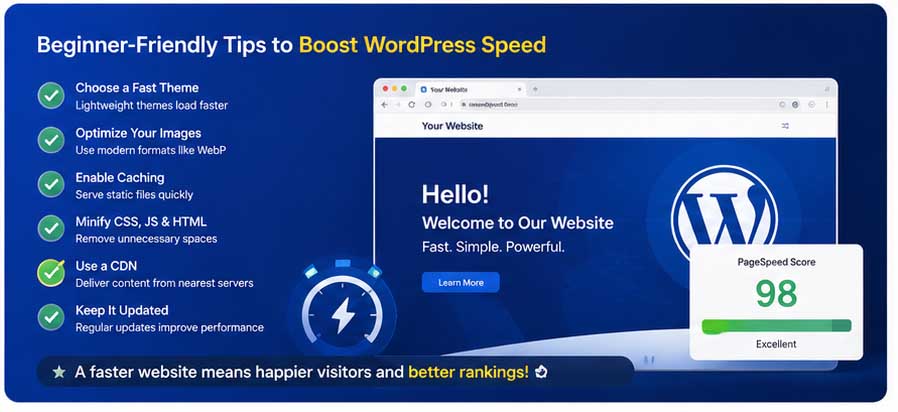
Luckily, most of these problems do not require any coding skills and can be easily solved with the proper tools and techniques!
1. Choose the Fastest WordPress Hosting
The performance of your website is primarily determined by the quality of your hosting provider.
Many new owners use low-cost shared hosting, which will slow down your site speed during high traffic periods.
For you to increase the WordPress loading speed, of your WordPress website, one of the best things you can do is to move to one of the fastest WordPress hosting.
Some of the features of a quality host include:
- NVMe SSD storage
- LiteSpeed web servers
- High uptime
- Fast server response time
- Advanced caching technology
- Optimized environment for WordPress
Companies like Amaizor that provide reliable hosting services offer fast-loading hosting services for your WordPress site.
2. Use a Lightweight WordPress Theme
Some WordPress themes have lots of animations and large items that make your site slower.
Using a lightweight, fast-loading theme such as the following will help:
- Astra
- GeneratePress
- Kadence
- Neve
By using a lightweight theme, you will improve your site’s performance in the following ways:
- Improves Mobile Speed
- Improves SEO Performance
- Improves Users Experience
These are all an important part of the WordPress performance optimization process.
3. Install a Caching Plugin
Caching creates static versions of your website pages so they load faster for visitors.
Without caching, WordPress generates pages dynamically every time someone visits your site.
Popular caching plugins include:
- WP Rocket
- LiteSpeed Cache
- W3 Total Cache
- WP Super Cache
Caching significantly improves WordPress loading speed and reduces server load.
Most caching plugins work with simple one-click settings.
4. Optimize Images Before Uploading
Slow websites are often heavily impacted by large images being used. You must optimize your images BEFORE you upload them to your WordPress website if you want to how to improve WordPress website speed
Some suggestions for image optimization include:
- Image compression
- Proper image resizing
- Use of WebP format
- Avoid uploading unnecessarily large image files
Some useful image optimization plugins you could use are:
- Smush
- ShortPixel
- Imagify
Optimized images will help you optimize your desktop and mobile website speed.
5. Remove Unnecessary Plugins
Having excessive amounts of plugins will negatively impact your site’s load time.
Certain plugins have many long-running processes which reduce response time.
To optimize performance:
- Remove any plugins that you don’t use.
- Avoid redundant plugins with duplicate functionality offering the same benefits.
- Consider using a more lightweight version of the plugin.
- Always use the latest version of a plugin.
Improving performance on a clean website is another straightforward way to enhance the performance of your WordPress performance optimization
6. Enable Lazy Loading
Lazy loading delays loading images and videos until users scroll down the page.
This reduces initial page loading time.
Most caching plugins now include lazy loading features.
Benefits include:
- Faster page speed
- Better mobile performance
- Reduced bandwidth usage
Lazy loading is an excellent method for improving WordPress loading speed.
7. Use a Content Delivery Network (CDN)
A CDN holds replicated copies of your site across multiple locations throughout the globe. When a visitor accesses your site, they will receive content from the closest CDN location.
Some major CDN providers are:
- Cloudflare
- BunnyCDN
- StackPath
Benefits of CDNs include:
- Increased global response time of the website to visitors
- Increased security of the website
- Better uptime of the website
- Enhanced User Experience
If you have an international audience, it is highly recommended that you use a CDN.
8. Keep WordPress Updated
Outdated versions of WordPress can negatively affect performance and increase security vulnerabilities.
Be sure to regularly update:
- WordPress core
- Themes
- Plugins
Keeping the software updated will improve compatibility with other technologies as well as increase the speed of the website.
Updating your installed software is one of the very first steps you can take to how to improve WordPress website speed.
9. Optimize Your WordPress Database
The WordPress database collects excess data such as:
- Spam comments
- Post revisions
- Trash items
- Temporary files
Database optimization plugins such as WP-Optimize help remove excess data.
Having a clean database will how to improve WordPress website speed.
as a whole.
10. Minify CSS and JavaScript Files
Minifying those files is a good way to make them smaller by removing any unnecessary spaces or characters from the code.
Many caching plugins will already take care of this process for you but consider these benefits of minifying your CSS and JavaScript:
- Improved page load speed
- Better scores for Google’s Core Web Vitals
Improved SEO results.
11. Limit External Scripts.
Your website may be slow because of external scripts that include advertisements, widgets, and tracking codes.
Here are some things you can do:
- Remove any scripts that are not needed.
- If you must use social sharing tools, choose lightweight ones.
- Limit your use of third-party integrations.
By reducing the number of external requests to your site, you can significantly speed it up.Lorem ipsum dolor sit amet, consectetur adipiscing elit. Ut elit tellus, luctus nec ullamcorper mattis, pulvinar dapibus leo.
12. Optimize for Mobile Devices
Mobile-devices account for most of the internet users.
Google uses mobile-first indexing.
Here are some tips to optimize your site for mobile users:
- Utilize responsive themes
- Image Compression
- Use Geo-Relevant CDN Caching
- Avoid Large Popups
Mobile Optimization is a significant part of WordPress Performance Optimization.
13. Use Fewer Fonts and Animations
The more customized the fonts/animations are in your design, the longer it takes to load.
- Keep your design clean and simple.
- To help achieve this, follow best practices:
- Keep your design to 1–2 font families
- Avoid unnecessary motion
- Minimize the number of large photo sliders
Frequently, a simple website will load much quicker than a complex one.
14. Monitor Website Speed Regularly
Using tools such as:
- Google Page Speed Insights
- GTmetrix
- Pingdom,
you can regularly check how fast your site loads. They are excellent means of finding WordPress related problems that could slow down page loads. Furthermore, by monitoring your page load time, you support sustained performance of your WordPress site over time.
Conclusion
You no longer need coding skills to understand how to improve WordPress website speed
With easy optimization methods, beginners can quickly enhance their site’s performance through the use of the right tools.
The essential steps to follow are:
- Select a fastest WordPress hostingg provider
- Install a caching plugin
- Optimize your images
- Remove plugins that aren’t needed
- Use lightweight themes
Web sites that perform better are not only good for SEO rankings, but they will also enhance visitor engagement with your website, lead to more conversions, and lead to more business.
Website speed is going to be mandatory in 2026.
Begin implementing these WordPress performance optimization today to build a faster, more productive website for your business using Amaizor. https://www.amaizor.com/wordpress-hosting/
FAQs
- Ways to Make Your WordPress Site Load Quicker Without Code
You can make your site load faster by doing things like using a caching plugin to save memory from the server; reducing the size of images on your site; upgrading to a better hosting plan; deleting any plugins you don’t use; and using fast loading, lightweight themes.
- Fastest WordPress Hosting Providers Available
Fastest WordPress hosting providers will have features such as SSD storage or NVMe storage, high-performance servers, caching tech and high uptime guarantees.
- What Causes Slow Load Times on My WordPress Site?
The commonly accepted reasons include poor quality hosting; images that are too big and range from 10KB to 600KB; multiple installed plugins; heavy theme designs; and no caching mechanism.
- Does Website Speed Affects of SEO?
Yes, Google considers page speed when ranking pages for search. Sites with shorter page load rates usually rank higher than those with longer page load times.
- What Is WordPress Performance Optimisation?
WordPress performance optimisation is the overall improvement of speed, response time, server performance and overall user experience of your site running on the WordPress platform.